What Contractors Should Know About PFAS in Site Water
.webp)
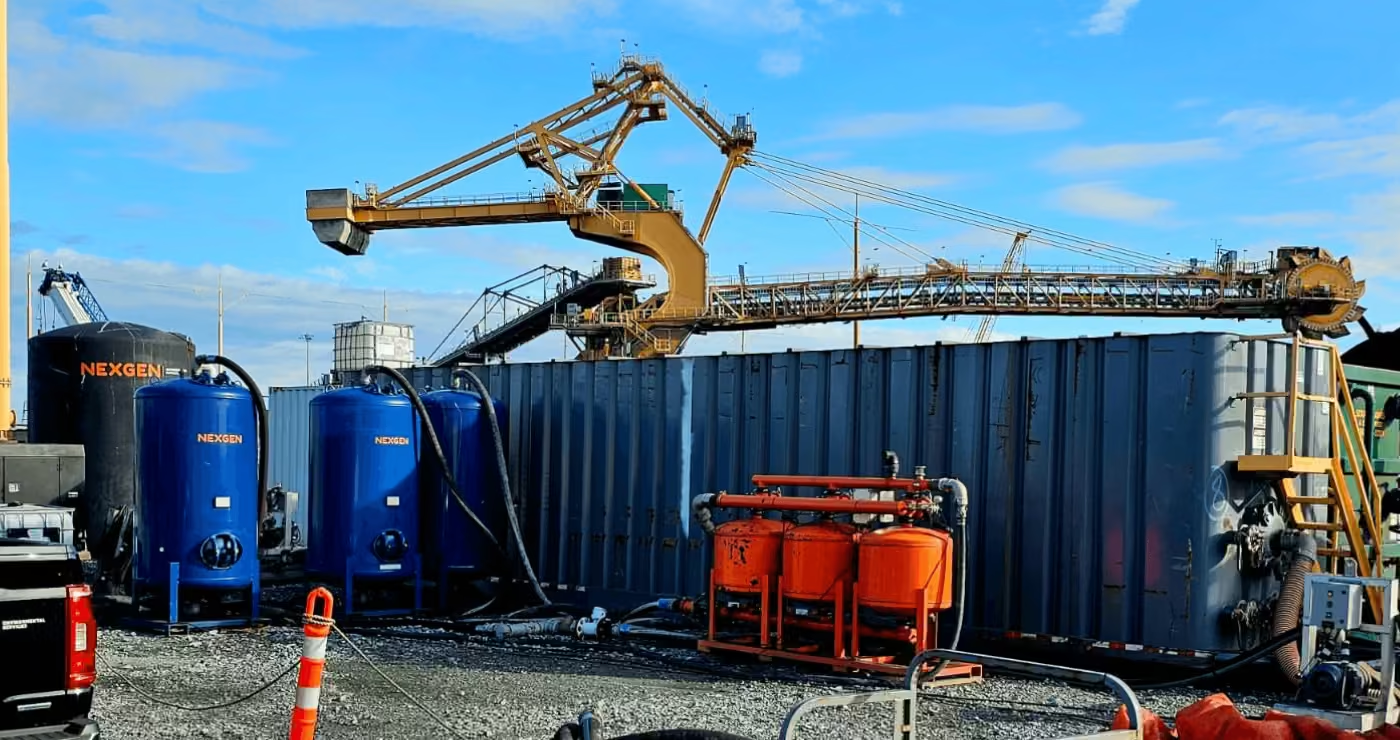
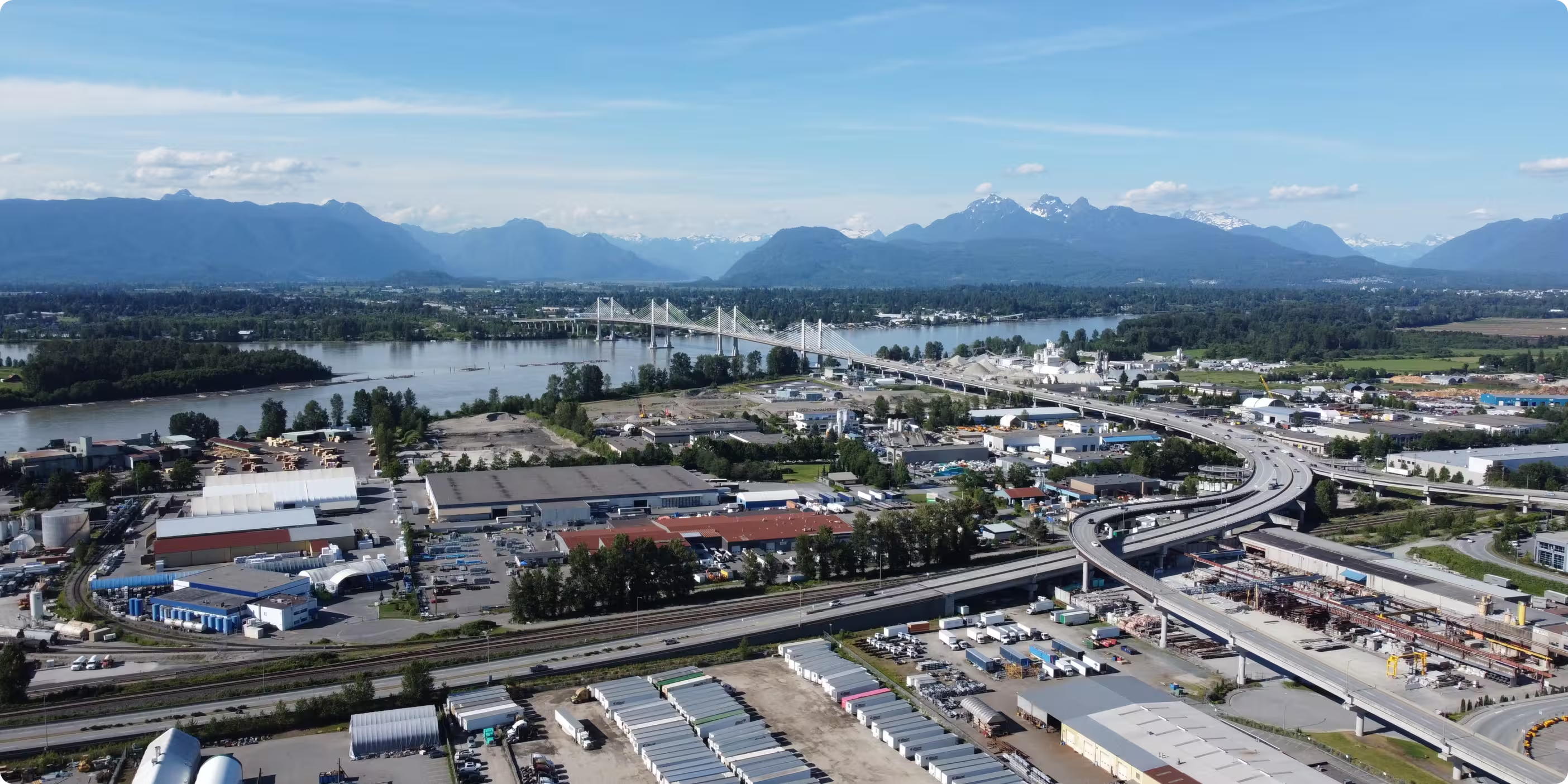
Construction dewatering setup managing PFAS‑impacted site water with temporary treatment equipment.
On a busy excavation, most water problems feel familiar – rising groundwater, a surprise spring, a storm that turns sideways – but PFAS‑contaminated water is different. Once these “forever chemicals” show up in sampling results, everyone from the superintendent to the environmental consultant is suddenly thinking about risk, liability, and who is on the hook for managing it while permits stay intact.
In this guide, we’ll focus on how PFAS ends up in construction water, what regulators care about in Western Canada, the main PFAS treatment technologies that work in the field, and how Nexgen Environmental’s contaminated water treatment systems can help you plan, run, and document a setup that stands up to scrutiny.
TL;DR for busy contractors
- PFAS are long‑lasting synthetic chemicals that can show up in groundwater, stormwater, and soil around industrial, landfill, and fire‑training sites.
- Regulators in Canada and the U.S. are driving PFAS limits in drinking water into the parts‑per‑trillion range – Health Canada’s current objective is 30 ng/L for the sum of 25 PFAS in drinking water (Health Canada drinking water objective) – which shapes expectations for construction discharges and soil handling.
- Practical PFAS treatment technologies for site water include granular activated carbon, ion exchange resin, and high‑pressure membranes, typically combined with solids removal and pH control.
- PFAS treatment and disposal needs to cover both the water stream and residuals (spent media, sludge, concentrate) so you’re not just shifting the liability from one bin to another.
- Having emergency pumping service, vacuum truck services, and pump repair services lined up can be the difference between a controlled response and a permit issue.
Table of contents
- Why PFAS in site water hits contractors differently
- What PFAS are and how they reach your excavation
- Regulatory pressure on PFAS in water and soil
- PFAS treatment technologies for construction site water
- Building a PFAS treatment and disposal plan
- Support services that keep PFAS systems running
- When to call a PFAS-focused dewatering partner
- Key takeaways for contractors
Why PFAS in site water hits contractors differently
If you’ve ever had a consultant call late in the week and say, “The lab picked up PFAS in the groundwater,” you know the pit‑in‑the‑stomach feeling. Sediment and hydrocarbons are familiar; PFAS brings new acronyms, new lab reports, and a much smaller margin for error.
PFAS (per‑ and polyfluoroalkyl substances) are a large family of human‑made chemicals used for decades in firefighting foams, stain‑resistant coatings, non‑stick products, and industrial processes. They don’t break down easily, tend to move with water, and can build up in people and wildlife, which is why they’re under such close scrutiny from health agencies and regulators.
For construction teams, the practical question is simple: “Can we still pump, treat, and discharge this water without blowing up the schedule or the budget?” The answer is usually yes – with the right plan, PFAS treatment technologies, and a field team that understands both the chemistry and the construction realities.
“With PFAS, you’re not just moving water; you’re moving liability.”
What PFAS are and how they reach your excavation
On most projects, PFAS is a legacy issue, not something the current work creates. It typically arrives with groundwater or fill affected by historical firefighting foam, industrial coatings or plating, landfills, airports, or wastewater plant discharges. If your site sits near one of these uses, shows up on a PFAS investigation map, or consultants are asking for PFAS‑specific sample bottles and ultra‑low detection limits, assume PFAS is possible and bring it into your dewatering and treatment planning early.
Regulatory pressure on PFAS in water and soil
Drinking water limits versus construction discharge
Health Canada now treats PFAS as a toxic group in drinking water and has set a 30 ng/L (30 ppt) objective for the sum of 25 PFAS in treated drinking water (Health Canada PFAS overview). In the U.S., the EPA’s final PFAS National Primary Drinking Water Regulation includes enforceable limits as low as 4 ppt for key compounds such as PFOA and PFOS (EPA PFAS drinking water rule).
Construction dewatering and bypass work is not drinking water treatment, but the same science is driving expectations. Municipalities, utilities, and regulators are starting to look at PFAS in discharge permits, industrial sewer‑use bylaws, and special conditions on high‑risk scopes. On PFAS‑affected sites, “pump and dump” is no longer an option.
PFAS soil treatment and disposal considerations
PFAS also binds to fine soils, organic‑rich sediments, and fill. Canadian guidance now addresses PFAS in soil and groundwater, so excavated material from hot spots may need special handling, separate stockpiles, and disposal at facilities permitted to receive PFAS‑impacted loads.
For contractors, that often turns into a two‑part strategy:
- PFAS soil treatment and disposal managed with the consultant and waste vendor (segregation, off‑site treatment or secure landfill, or specialized soil washing/stabilization), and
- PFAS‑focused water treatment wrapped into the dewatering or bypass scope.
PFAS treatment technologies for construction site water
The good news: you don’t need a research lab to manage PFAS‑impacted water on a construction project. Field‑proven PFAS treatment technologies already exist, and many of them build on the same pressure vessels, filters, and control gear you use for other contaminants.
.webp)
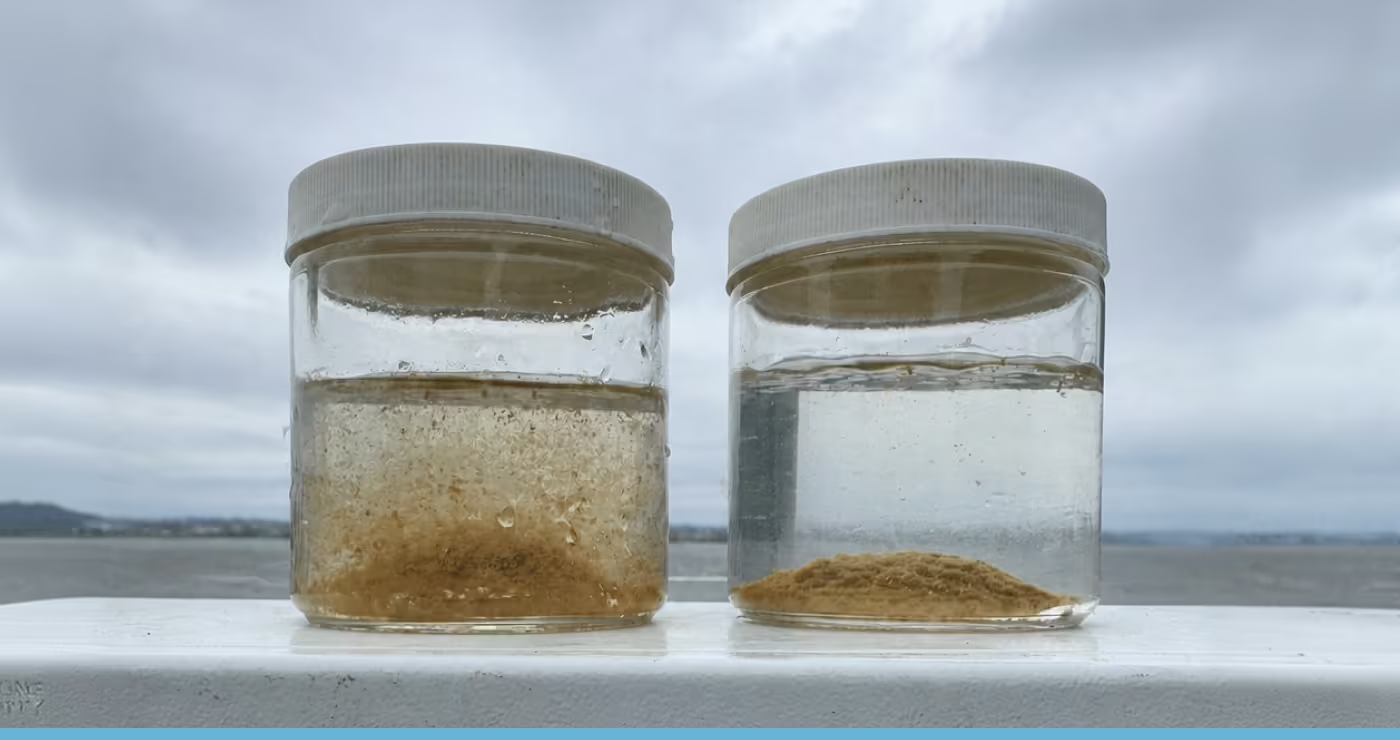
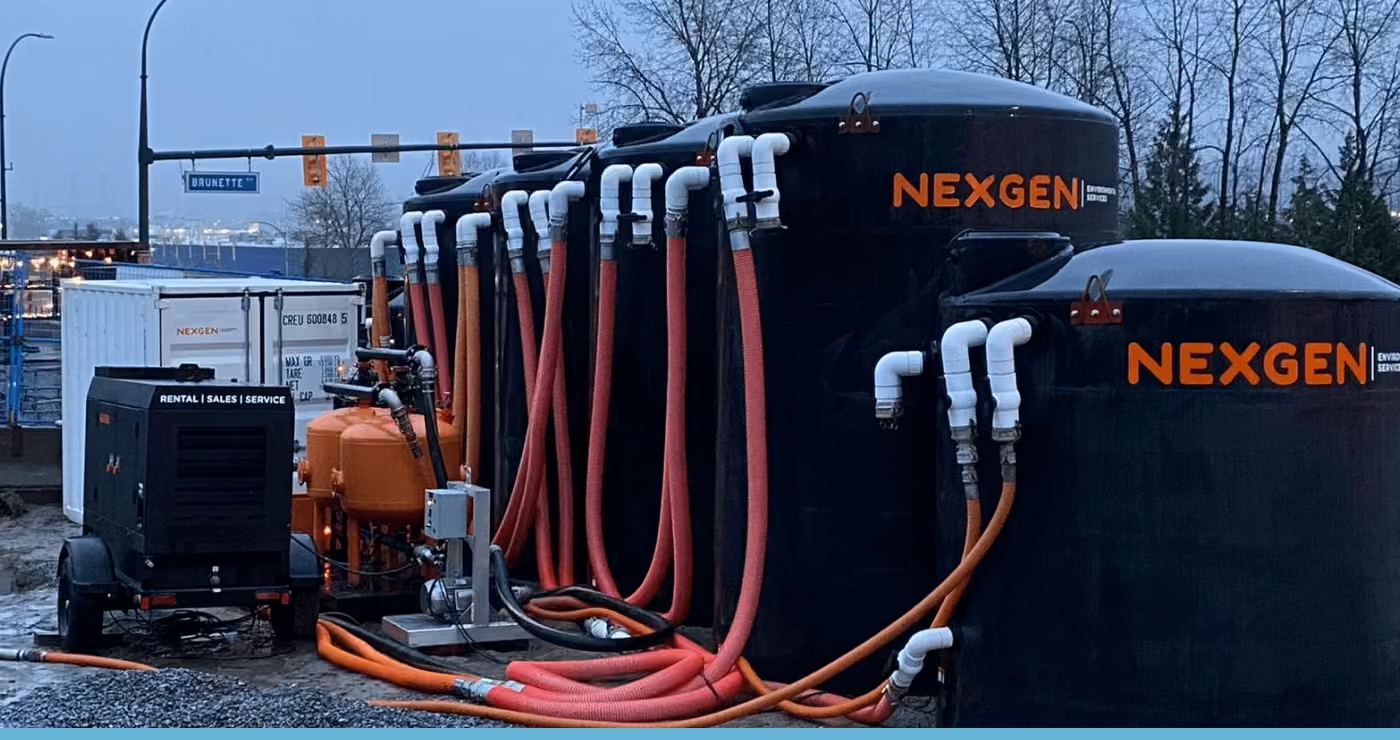
Modular water treatment system using pressure vessels and tanks, similar to PFAS treatment trains used on construction projects.
Most full‑scale systems in use today rely on three main families of technology – granular activated carbon, ion exchange resin, and high‑pressure membranes – arranged in a treatment train and supported by sediment removal and pH control, similar to the approaches summarized in EPA PFAS treatment technologies.
| PFAS Treatment Technology | How It Works | Where It Fits on Site |
|---|---|---|
|
Granular activated carbon (GAC) |
PFAS molecules stick to porous carbon media as water passes through columns. | Common polishing step after solids removal on moderate-flow jobs. |
| Ion exchange resin | Specialized anion exchange resin beads attract and hold negatively charged PFAS. | High-performance option when footprint is tight or effluent targets are strict. |
|
High-pressure membranes (RO/NF) |
Reverse osmosis or nanofiltration physically separate PFAS and other dissolved ions from water. | Used where space is limited or multiple dissolved contaminants need treatment. |
Granular activated carbon (GAC)
GAC is often the first PFAS treatment technology people think of. Packed carbon beds in pressure vessels are sized so water spends enough time in contact with the media for PFAS to adsorb. GAC is well‑understood, relatively simple to operate, and can be a good fit when flows are moderate and influent concentrations aren’t extreme.
The trade‑offs are footprint and media usage: large construction flows can require big vessels and careful change‑out planning to stay ahead of breakthrough. Spent carbon and any PFAS‑rich backwash water then become part of your PFAS treatment and disposal plan.
Ion exchange resin systems
Ion exchange resin – especially PFAS‑selective resin – has become a workhorse option for PFAS treatment in municipal and industrial settings. Anion exchange resins can treat high volumes of PFAS‑contaminated water per unit volume of media, which is useful when space is tight and flows are high, as summarized in EnviroWiki anion exchange.
On a Nexgen‑style setup, resin vessels slot into the same skid and manifold approach used for other specialty media. Upstream, sediment removal systems and pH control protect the resin from fouling; downstream, sampling ports track breakthrough so change‑outs happen on your schedule, not the regulator’s.
Nexgen’s ion exchange resin services are already deployed on contaminated water treatment systems, so PFAS projects can often build on gear and experience the team uses daily.
High‑pressure membranes and other emerging options
Reverse osmosis (RO) and nanofiltration (NF) can remove a wide spectrum of PFAS, metals, and dissolved salts in a single step, producing a clean permeate stream and a PFAS‑rich concentrate. For contractors, the question is whether the added complexity, power draw, and concentrate management make sense compared with GAC or ion exchange.
On the research side, technologies like foam fractionation and advanced oxidation are being tested to help concentrate or destroy PFAS, often as part of a multi‑step treatment train. For now they are still emerging for day‑to‑day construction use, but they point toward a future where PFAS‑laden media and liquids can be destroyed rather than just stored (foam fractionation overview).
Building a PFAS treatment and disposal plan
No two PFAS sites are identical, but the projects that run smoothly tend to tackle the same four questions up front. Think of this as a quick framework you can run through before the first pump hits the ground.
.webp)
Contractors and environmental specialists coordinating PFAS treatment and disposal around an active excavation.
1. What’s really in the water and soil?
Work with your consultant to confirm:
- Which PFAS compounds are present (and at what ranges)
- Whether soil or bedrock is also impacted, which affects PFAS soil treatment and disposal tactics
- Other contaminants that may share the same treatment train (metals, hydrocarbons, high TSS, pH swings)
2. Where can the water go?
Discharge options – storm, sanitary, reuse, or haul‑off – shape everything that follows. Tighter discharge limits drive you toward higher‑performance PFAS treatment technologies and a more detailed sampling plan. If PFAS rules are still evolving in your jurisdiction, aligning early with the utility or regulator heads off tough conversations later.
3. How will the system fit the physical job?
This is where a PFAS‑literate dewatering and treatment partner earns their keep. Together you should look at:
- Expected flow rates and surge conditions (especially for combined dewatering and bypass work)
- Available footprint for treatment skids, tanks, and hose runs
- Access for equipment rentals, vacuum trucks, and media change‑outs
- Safe power, chemical storage, and noise constraints in tight urban corridors
4. What happens to residuals?
A workable PFAS treatment and disposal strategy covers more than just the clean effluent. It also addresses spent GAC or ion exchange resin, PFAS‑rich sludge from clarifiers, any RO concentrate if membranes are used, and solids captured by vacuum truck services. Routing those streams to appropriate off‑site treatment or secure disposal is part of closing the loop, not an afterthought.
For example, on a mid‑rise project near a former fire‑training area in Metro Vancouver, pre‑construction sampling found PFOS and PFOA above local guidelines. The contractor, consultant, and PFAS‑focused dewatering partner designed a 500–700 gpm treatment train with inlet pumps to a weir tank for solids removal, pH adjustment, and dual ion exchange vessels ahead of discharge to sanitary sewer. Clear roles for media change‑outs, vacuum truck cleanouts, and reporting meant every PFAS result stayed below permit limits and the team handled wet‑weather surges without missing a single sampling event.
For a broader look at matching treatment trains to construction scopes, see Nexgen’s job-site water treatment guide.
Support services that keep PFAS systems running
Once a PFAS system is online, keeping it stable is as much about field support as it is about chemistry. A clogged suction, a downed pump, or a media change‑out that runs long can quickly back up flows and raise nerves with regulators and neighbours.
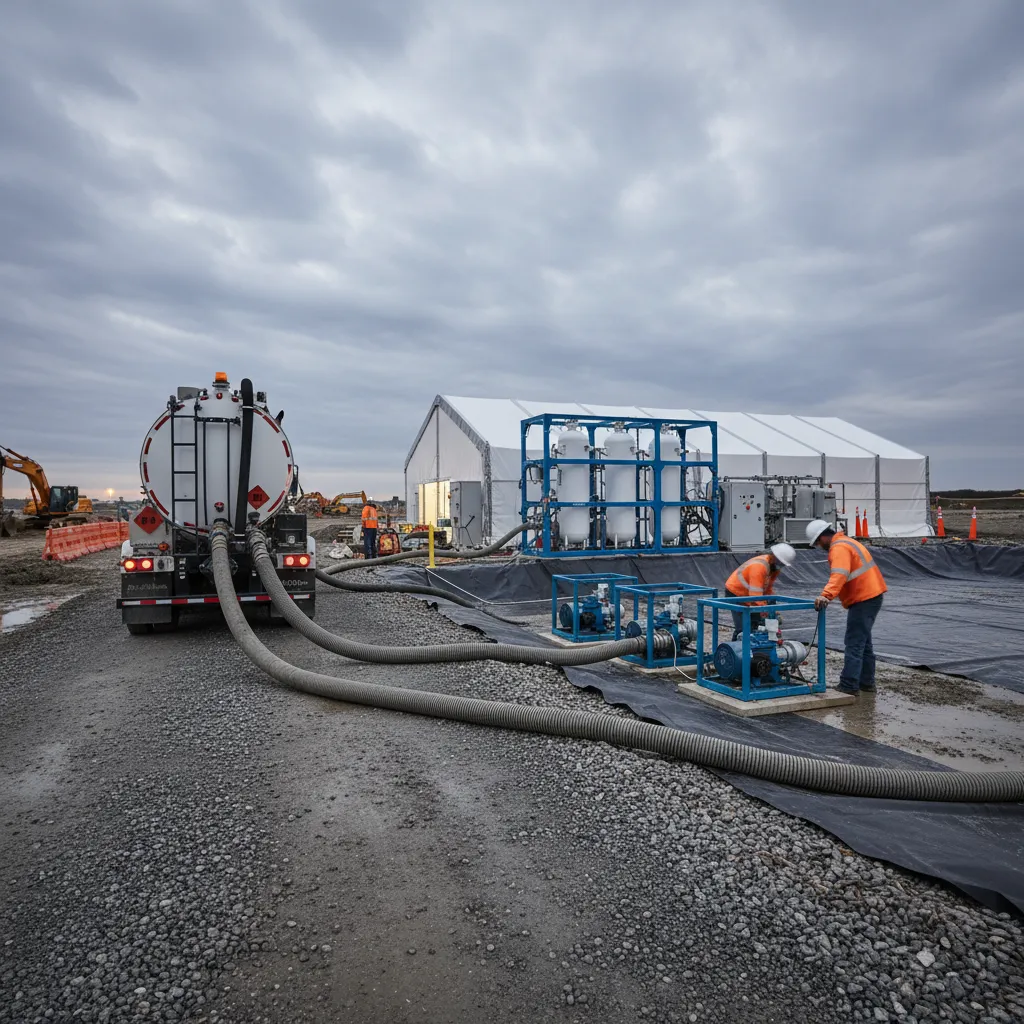
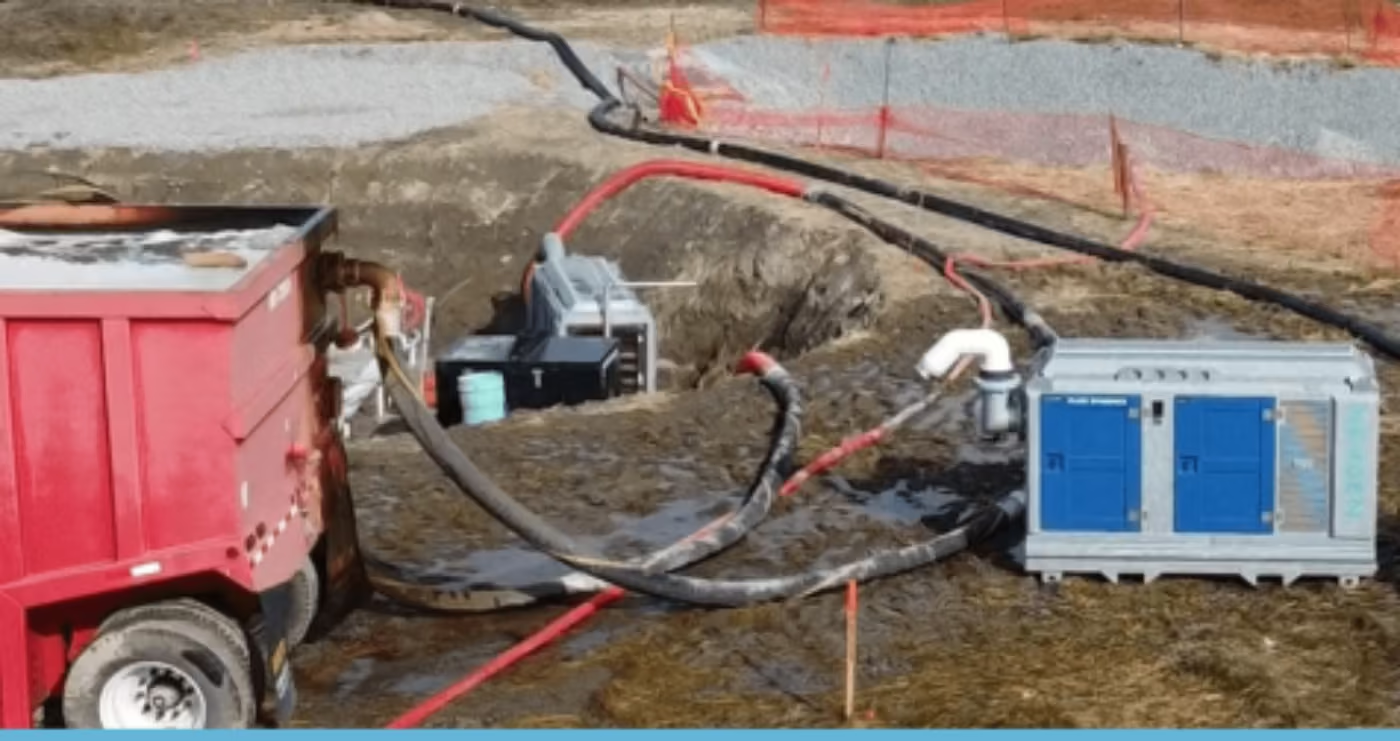
Vacuum truck, portable pumps, and hose runs providing bypass and residuals management for PFAS‑impacted site water.
Emergency pumping service and bypass setups
On PFAS‑affected projects, contingency capacity matters. Having emergency pumping support and bypass systems ready lets you respond to a blocked sewer, a surprise inflow, or a storm event without discharging untreated water. Nexgen’s teams regularly combine bypass pumping with construction dewatering and treatment setups.
Vacuum truck services and residuals management
PFAS doesn’t just sit in clear water lines; it can concentrate in sludge, sumps, and low‑point tanks. Nexgen’s vacuum truck services remove water and sediment from the site and haul them to appropriate treatment or disposal facilities, helping manage PFAS‑laden fines and clean out vessels or frac tanks between phases.
Pump repair services and field troubleshooting
PFAS projects often run for months, not days. During that time, pumps wear, solids shift, screens plug, and conditions change. Local pump repair services and field technicians who can swap, service, or reconfigure equipment mid‑shift keep the treatment train running and the sampling program on track.
When to call a PFAS-focused dewatering partner
You don’t need a PFAS specialist on every project. But there are clear flags that it’s worth bringing in a team that handles contaminated water treatment systems every week:
- PFAS shows up in pre‑construction sampling or historical reports
- The site sits near a known PFAS source area, investigation, or plume
- Your discharge permit references PFAS explicitly or requires advanced treatment
- The project combines high flows, tight streets, and sensitive receptors (creeks, intakes, schools)
- You need support with documentation, telemetry, and regulator‑ready reporting
Nexgen’s team brings together dewatering, water treatment, resin selection, and compliance support across Western Canada, backed by memberships in organizations such as CWQA and ESCABC. That combination helps contractors line up PFAS treatment, monitoring, and field services under one roof instead of stitching together multiple vendors mid‑project.
If you’re scoping a PFAS‑affected job in Metro Vancouver, the Fraser Valley, or Alberta, reach out early. A 30‑minute conversation can save days of redesign in the field. You can request a free consultation with the Nexgen team to talk through flows, lab data, and treatment options before mobilization.
Key takeaways for contractors
- PFAS in site water changes the stakes, but not the goal: you still need reliable pumping, clear discharge paths, and manageable risk.
- Early conversations with your consultant, regulator, and dewatering partner help line up PFAS soil treatment, water treatment, and disposal into one plan.
- Field‑tested PFAS treatment technologies – especially GAC and ion exchange resin – can be deployed with familiar pressure vessels, pumps, and tanks.
- Residuals (spent media, sludge, concentrate) deserve as much attention as the treated effluent in your PFAS treatment and disposal strategy.
- Support services such as emergency pumping service, vacuum truck services, and pump repair services keep the whole system running when conditions shift mid‑job.
Handled thoughtfully, PFAS doesn’t have to derail your schedule. With solid information, practical technology, and a specialist team on your side, you can keep excavations workable, regulators satisfied, and your crew focused on building – not bailing out of last‑minute water problems.